Pigeons & the ordinary worth of life
On the Bird Who Remained
A Meditation on Pigeons, Augury, Affection, and the Ordinary Worth of Living Things
Contents · Nine sections and reference notes
I. The Ordinary Bird
There is a bird we have become very good at not seeing.
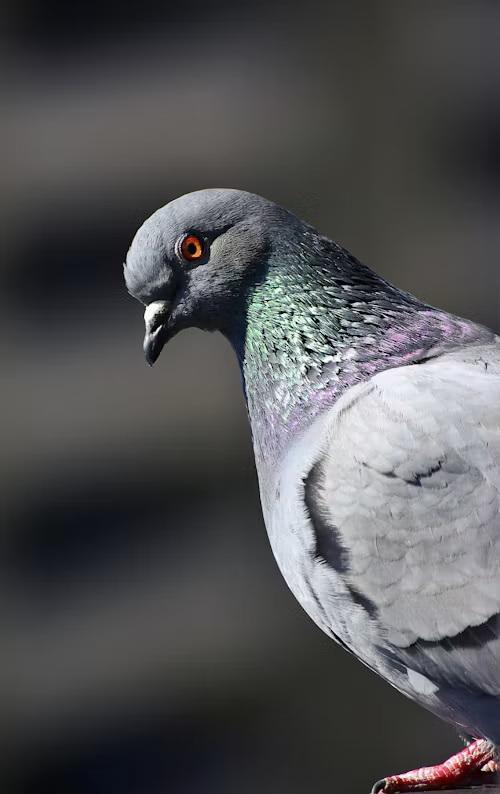
He walks along the pavement with a peculiar determination, advancing his head, pausing, and then allowing the rest of his body to catch up.
His feet are pink.
His eyes are bright.
At his throat, the sunlight produces an extraordinary arrangement of green and violet, which disappears almost as soon as he turns away.
He is a pigeon.
There are many reasons we might not notice him.
He is common. He is familiar. He occupies spaces we regard as belonging principally to ourselves. He does not generally sing in a manner we find beautiful, nor does he possess the novelty of a rare visitor.
His presence is so ordinary that we have nearly ceased to regard it as a presence at all.
And yet there he is.
A small animal, possessed of an independent life, navigating a world whose arrangements he did not choose.
If we pause to observe him, something interesting happens.
The movement of his head, which may appear comical, serves an important visual function. Researchers studying pigeon locomotion have demonstrated that the head remains remarkably stable during part of each walking step, helping the bird maintain a steady visual image while its body moves forward.
What looks to us like a peculiar little dance is, in part, a solution to a problem of perception.
The bird is not behaving absurdly.
We have merely been observing him without understanding what he is doing.
There is a modest lesson here.
How much of what we dismiss as foolish is simply unfamiliar to us?
And how often have we confused familiarity with understanding?
Yet there is another danger in beginning this way.
We may be tempted to defend the pigeon by announcing that he is, after all, extraordinary.
We may describe his navigation, intelligence, memory, or usefulness. We may offer a history of his service to humanity. We may assemble a considerable argument demonstrating why a creature so frequently dismissed deserves our admiration.
All these things may be worth knowing.
But they leave another question unanswered.
What if the ordinary pigeon was sufficient all along?
II. The Animal We Brought With Us
The pigeon did not arrive in the modern city as an entirely independent stranger.
The familiar urban pigeon belongs to Columba livia, the rock pigeon, or rock dove.
Its wild ancestors nested upon rocky cliffs and sheltered ledges. Over thousands of years, human beings domesticated pigeons for food, communication, companionship, racing, and ornamental breeding.
Many of the pigeons inhabiting modern cities descend from domesticated birds that escaped or were released and established free-living populations.
Their relationship with our settlements is therefore not an accident of recent urban development.
It is an inheritance.
Human beings bred them, transported them, housed them, and encouraged particular qualities in them.
Then we built cities.
Our buildings resembled cliffs.
Our bridges provided shelter.
Our ledges became nesting places.
Our discarded food supplied sustenance.
The pigeons adapted to the conditions we made available.
And having established environments in which these animals could survive, we sometimes expressed considerable displeasure when they did.
This does not mean that pigeons possess an unlimited entitlement to occupy every building, or that their presence creates no legitimate problems.
It means only that our history with them deserves a place in our understanding of those problems.
A pigeon nesting beneath a bridge does not know that the bridge was constructed for another purpose.
He knows that there is shelter.
He knows that there is a place to rest.
He may know that another pigeon has found the same place suitable for raising young.
The distinction between intended infrastructure and unintended habitat belongs to us.
The bird has made no such distinction.
It lives within the circumstances available to it.
And if those circumstances have been shaped by centuries of human activity, perhaps our responsibilities cannot be limited to demanding that the animal disappear whenever its presence becomes inconvenient.
III. The Bird We Asked to Speak
Long before the pigeon became a familiar inhabitant of railway stations and public squares, birds occupied a considerable place in humanity's attempts to understand the world.
Ancient peoples observed their movements, calls, and appearances, sometimes treating them as signs of divine intention.
Among the Romans, augury formed part of the religious and political life of the community.
Certain birds were observed according to established practices. Their flight, calls, or feeding behavior could be interpreted as auspicious or unfavorable.
Eagles and other birds of prey held particular places within these traditions, as did ravens, crows, and several other designated birds. The feeding behavior of sacred chickens also became an established means of taking auspices.
The ordinary city pigeon was not the principal bird of Roman state augury.
But doves, members of the same broader family, appeared elsewhere in the religious and literary imagination of antiquity.
In Book VI of Virgil's Aeneid, two doves appear before Aeneas as he searches for the golden bough.
He recognizes them as birds associated with his divine mother, Venus, and follows their flight toward the tree he seeks.
The birds become guides.
Their movements acquire significance because a human observer interprets them within a sacred story.
There is another, older account that deserves particular attention.
In the second book of his Histories, Herodotus records traditions concerning the establishment of the oracle at Dodona.
According to one account, two black doves flew from Egyptian Thebes. One reached Libya. The other came to Dodona, where it settled upon an oak tree and spoke with a human voice, declaring that an oracle should be established there.
It is a remarkable story.
But Herodotus does not leave it entirely undisturbed.
He also records an account involving women taken from Egypt and sold into distant lands.
He proposes that the supposed speaking dove may have been an Egyptian woman whose unfamiliar language sounded to local listeners like the cries of a bird.
When she learned to speak a language they understood, the dove was said to have begun speaking with a human voice.
Whether Herodotus's explanation accurately reconstructs the origin of the tradition is another matter.
What interests me is the possibility he recognized.
An extraordinary interpretation may arise from something the observer does not understand.
And sometimes the explanation of a mysterious voice tells us as much about the listener as about the one who speaks.
The woman, in Herodotus's reconstruction, had possessed a human voice all along.
It was the understanding of her listeners that had changed.
There is a curious lesson in this history.
Human beings have long looked toward birds and asked them to reveal something beyond themselves.
The future.
The will of the gods.
The direction of an uncertain journey.
The meaning of an unfamiliar voice.
We have been remarkably willing to make their presence significant.
Yet the bird itself was not necessarily consulted.
Its flight was observed.
Its movement interpreted.
Its meaning assigned.
These ancient traditions deserve to be understood within their own religious and historical settings. They were not composed merely to furnish modern readers with convenient illustrations.
Nevertheless, they invite a question that remains intelligible today.
When we look at another creature, how much of what we believe we see belongs to the creature, and how much have we brought with us?
IV. The Messenger
We have not always regarded pigeons principally as nuisances.
For centuries, human beings cultivated their capacity to return to familiar places.
Homing pigeons became a means of carrying information across distances when other methods of communication were unavailable, unreliable, or dangerously exposed.
During the First World War, pigeons served in military communications.
The United States Army Signal Corps established a Pigeon Service in 1917. These birds carried messages through circumstances in which telephone wires could be severed and human messengers could be wounded or killed.
Among the most famous was Cher Ami.
The Smithsonian's National Museum of American History preserves the bird's remains and documents its wartime service.
Cher Ami has become closely associated with the rescue of American soldiers known as the Lost Battalion in October 1918.
The surviving records, however, do not conclusively establish that Cher Ami carried the particular message most often credited to the bird in later retellings.
The bird's service is documented.
The familiar legend contains uncertainties.
That distinction matters.
We should not need to embellish an animal's life to recognize that something significant occurred.
Nor should we mistake the purposes for which human beings used an animal for the whole of what that animal was.
A carrier pigeon did not understand the political objectives of the war.
It did not choose the conflict.
It did not deliberate upon the legitimacy of the orders carried in a small container attached to its body.
It had been bred and trained to return home.
Human beings made use of that capacity.
Sometimes the consequences were extraordinary.
Lives could depend upon the arrival of a message.
But the pigeon itself remained a bird.
It sought a familiar place.
It flew toward home.
Human beings, recognizing that an ordinary capacity could serve an extraordinary purpose, gave the animal a place within the machinery of war.
There is something worth examining in the difference between the animal's purpose and our own.
We called the pigeon valuable when it carried our messages.
We commemorated particular birds when they survived dangers into which human beings had placed them.
We preserved their remains and recounted their service.
And yet the modern pigeon, descended from the same long association between our species, is often regarded as an unwelcome occupant of the city.
The contrast is not absolute. Many people continue to raise, admire, protect, and care for pigeons.
Nevertheless, it raises an uncomfortable question.
When a creature ceases to be useful in the manner we once required, what happens to our willingness to recognize its worth?
V. The Bird Who Was Loved
There is a story about Nikola Tesla that complicates this question in a rather beautiful way.
Tesla is remembered principally for his contributions to electrical engineering.
His experiments, inventions, ambitions, and disappointments occupy a substantial place in the history of modern technology.
But in his later years in New York City, he also became known for feeding pigeons.
Among them, according to the recollections of his friend and biographer John J. O'Neill, was a particular white pigeon with pale gray markings upon her wings.
Tesla reportedly recognized her individually.
He described her returning to him.
He spoke of caring for her when she was ill.
And he expressed an attachment to her that he compared to the deepest forms of human affection.
O'Neill's account, published after Tesla's death, includes a dramatic description of the bird's final visit and a light Tesla said he perceived in her eyes.
We should distinguish the evidence of Tesla's attachment from the extraordinary details of that recollection.
The reported light is not independently established as a physical event.
Nor does the narrative permit us to know precisely what the pigeon understood of her relationship with Tesla.
The account tells us something about Tesla's experience and the meaning he assigned to it.
It tells us considerably less about the interior life of the bird.
But there is another distinction worth preserving.
Tesla's affection did not depend upon the pigeon carrying an important message.
He did not require her to solve an engineering problem.
She did not need to become a remarkable specimen of animal intelligence.
She was a particular living creature whom he had come to recognize and care about.
It is tempting to find this surprising.
We readily understand affection for a dog.
We can appreciate a horse.
We recognize the bond between a human being and a familiar cat.
But a pigeon?
A small, common bird?
One among thousands?
Perhaps our surprise reveals something about the hierarchy of affection we have constructed.
We have decided that certain animals are natural recipients of intimacy, while others belong principally to the categories of utility, nuisance, or indifference.
The animals themselves have not agreed to these classifications.
They merely live within them.
And sometimes a human being notices an individual where others perceive only an interchangeable member of a species.
Tesla's attachment should not be treated as proof of a reciprocal relationship beyond what the evidence permits.
But neither must we dismiss it merely because the object of his affection was a pigeon.
A person may find companionship in a living creature without requiring the creature to understand companionship in human terms.
Care need not depend upon perfect mutual comprehension.
It may be enough that an individual is recognized.
That its needs are noticed.
That its absence would matter.
Yet even affection presents an ethical difficulty.
For to love another creature is not necessarily to understand it.
We may care deeply and still misunderstand what the creature needs.
We may mistake our own wishes for its preferences.
We may make its life central to our story while knowing remarkably little of the world as it experiences it.
Affection is therefore a beginning, not the completion of responsibility.
It must remain willing to learn.
The most useful question may not be whether Tesla's pigeon loved him in the manner he believed.
It may be whether his care recognized that the bird had needs and a life of her own.
And whether our own affection for animals can learn to do the same.
VI. The Intelligence We Overlooked
It would be convenient to suppose that pigeons are especially simple animals.
They do not ordinarily impress us with the conspicuous problem-solving displays we associate with certain parrots or corvids.
They do not appear particularly interested in demonstrating intelligence for human approval.
Nevertheless, experimental research describes considerably more sophisticated capacities than casual observation may suggest.
Pigeons can learn to distinguish and categorize complex visual information.
In a 1995 study, researchers Shigeru Watanabe, Junko Sakamoto, and Masumi Wakita trained pigeons to discriminate between reproductions of paintings by Claude Monet and Pablo Picasso.
The birds learned the distinction and demonstrated some ability to generalize their responses to paintings they had not previously encountered.
This does not establish that pigeons understand painting as art historians do.
It does not mean that a pigeon possesses an aesthetic philosophy.
It demonstrates that the bird's perceptual and learning capacities can support forms of visual discrimination more complicated than we might have expected.
There is something wonderfully amusing about the experiment.
A creature dismissed by some city dwellers as unintelligent was being taught to distinguish modern painting.
The pigeon, presumably, had not requested admission to an art appreciation course.
Nevertheless, the experiment offers a useful corrective to our assumptions.
A creature's apparent simplicity is not reliable evidence of the simplicity of its capacities.
But here again, we should be careful.
We may be tempted to defend the pigeon by explaining that he is cleverer than we thought.
And he may indeed be.
But what if he were not?
What if his ability to distinguish photographs were quite limited?
What if he could not learn to recognize paintings?
What if he possessed none of the capacities we find particularly impressive?
Would that relieve us of every obligation concerning his treatment?
I do not think it would.
Knowledge of animal cognition can deepen our understanding of a creature and help us make better decisions about its welfare.
It should not become the sole basis upon which humane treatment is permitted.
The pigeon that learns to distinguish Monet from Picasso is a fascinating bird.
The pigeon that does not is still a living one.
The animal's ability to impress us is not the origin of every responsibility we may owe it.
VII. The Inconvenient Neighbor
There is, of course, an objection.
Pigeons can create genuine problems.
Large concentrations of birds may produce substantial accumulations of droppings.
Nesting sites may interfere with building maintenance.
Congregations around accessible food sources can create sanitation concerns.
Under particular environmental conditions, disturbing accumulated material contaminated with bird droppings can also create health risks, including exposure to environmental fungi.
Such circumstances should not be confused with the risks of simply encountering a pigeon on a sidewalk.
The conditions of exposure matter.
We need not deny these realities to treat pigeons compassionately.
Indeed, denying them would be a poor beginning.
Compassion that cannot acknowledge legitimate human needs eventually becomes difficult to sustain.
But acknowledging a problem does not establish that every proposed response is justified.
If a building contains an unsafe accumulation of droppings, the appropriate question is how to restore safe conditions.
If discarded food attracts unusually large numbers of birds, the appropriate question is how those food sources may be managed.
If pigeons occupy a location where nesting creates a serious hazard, the appropriate question is whether access can be safely prevented without unnecessarily harming birds already present.
These are practical matters.
They require knowledge of animal behavior, sanitation, building maintenance, and the effectiveness of available interventions.
Humane wildlife management may involve reducing accessible waste, discouraging inappropriate feeding, modifying structures, and using properly designed exclusion measures.
Such measures must themselves be evaluated for their effects upon animals, including the danger of trapping birds or separating dependent young from their parents.
There is a useful lesson here.
Kindness is not always the same as giving an animal what it appears to want.
Nor is humane treatment always the same as allowing an unsafe situation to continue indefinitely.
Sometimes responsible care requires boundaries.
Sometimes it requires cleaning.
Sometimes it requires changing our own habits.
We need not choose between indifference and indiscriminate indulgence.
There is a considerable field of practical compassion between them.
And it is within that field that the responsibilities of sharing a city may be examined.
A pigeon may be inconvenient.
That does not require us to regard it with contempt.
VIII. The Names We Give
A pigeon may be described as wildlife.
Or as a feral domestic animal.
Or as a companion.
Or as a messenger.
Or as a sacred sign.
Or as a nuisance.
The biological creature has not necessarily changed.
What has changed is the relationship in which human beings have placed it.
These categories are not interchangeable, nor are they without legitimate purposes.
Wildlife management, veterinary medicine, religious history, animal husbandry, and municipal sanitation all require distinctions.
But a category intended to help us understand or administer something can become misleading when we mistake it for the whole truth about the creature.
The word nuisance may describe an effect.
It does not describe the entirety of a life.
And the word sacred, however meaningful within a religious tradition, does not necessarily tell us anything about what the bird experiences.
The word hero may preserve our gratitude.
It does not explain why the bird flew.
The word beloved may describe an attachment.
It does not provide complete knowledge of the creature who is loved.
There is no need to discard these words.
There is reason to recognize their limits.
Human institutions frequently organize the world according to purposes.
Roads are for transportation.
Buildings are for habitation.
Public squares are for gathering.
Warehouses are for storage.
The creatures that enter these arrangements do not necessarily recognize the intentions governing their construction.
They encounter surfaces, shelter, food, danger, and opportunity.
They respond according to their capacities.
We, however, possess the ability to examine our purposes and revise our arrangements.
The pigeon cannot read the municipal ordinance.
We can.
The pigeon cannot understand the public-health regulations governing its nesting place.
We can.
The pigeon cannot participate in deciding how a city will respond to its presence.
We can.
That difference does not mean the bird possesses the political status of a human citizen.
It does not erase the distinct legal and moral responsibilities governments owe to people.
It means that our greater capacity for deliberate judgment should inform the way we exercise control over the creatures sharing our environments.
We can distinguish effective management from unnecessary cruelty.
We can anticipate consequences.
We can investigate whether an intervention addresses a genuine problem or merely satisfies our desire to remove whatever displeases us.
And we can recognize that the lives affected by our decisions are not exhausted by the categories through which we administer them.
These responsibilities arise from our own capacities.
They do not require the pigeon to become anything other than a pigeon.
IX. On Remaining
There is another fact about pigeons that I find rather beautiful.
Both parents participate in feeding their young.
Pigeons produce a nutrient-rich substance commonly called crop milk, which is supplied to newly hatched chicks before they gradually transition toward other food.
It is not mammalian milk.
It is not evidence that pigeons organize family life according to human customs.
It is simply a remarkable biological adaptation through which young birds receive the nourishment necessary to survive.
A pigeon sitting beneath a bridge may be resting.
It may be waiting for another bird.
It may be tending a nest.
It may be doing something we have not understood.
And we may walk beneath it without noticing any of these things.
Our failure to notice does not make its life less real.
The pigeon existed before our attention arrived.
It will continue after our attention moves elsewhere.
We have made much of this animal.
We have asked birds to reveal the intentions of gods.
We have followed doves toward the golden bough.
We have trained pigeons to carry messages through war.
We have preserved particular birds as symbols of courage.
We have loved them.
We have studied their intelligence.
We have accused them of making our cities dirty.
We have built memorials to some and erected barriers against others.
Across these very different histories, the bird has remained.
Not unchanged, for domestication and human activity have shaped the lives of pigeons over many generations.
But still a living creature whose existence exceeds the meanings we assign it.
There is a temptation, upon arriving at this conclusion, to make the pigeon a symbol of something larger.
Resilience, perhaps.
Or innocence.
Or the persistence of life beneath the weight of human civilization.
There are worse things to symbolize.
But perhaps we have asked enough of him.
Perhaps the bird need not carry one more message.
Perhaps he need not become an omen, a messenger, a beloved companion, an experiment, or a moral illustration before we are willing to regard him with a little care.
We may learn something from observing him.
We may discover that creatures we regard as unremarkable possess capacities we had never troubled to investigate.
We may find ourselves reconsidering what it means to live among other beings without requiring that they justify their existence through service to us.
These are legitimate reflections.
But the bird does not owe them to us.
It has not appeared in the city to improve our character.
It has not come to offer a parable.
It has not consented to become a symbol of our better intentions.
It is simply trying to live.
And perhaps our most useful conclusion is also our most modest.
We need not admire everything about the pigeon to recognize that our dealings with it should be informed by knowledge, restraint, and compassion.
We may manage the spaces we share.
We may establish reasonable boundaries.
We may protect public health and preserve the usefulness of buildings.
But we need not cultivate contempt for the animals affected by those decisions.
The bird is not an enemy because it has become inconvenient.
Nor is it virtuous because it once carried our messages.
It is not more deserving because it can distinguish paintings.
It is not less deserving because we encounter it every morning.
And it need not become extraordinary before we are willing to notice it.
Tomorrow morning, a pigeon will walk along the pavement.
He will advance his head, then his body.
He will turn toward the sunlight.
For a moment, the feathers at his throat will become green, then violet.
He will find something to eat.
Perhaps another pigeon will join him.
The city will continue around them.
People will hurry to work.
Traffic will move.
Doors will open.
Somewhere, a person may pause long enough to notice.
And the pigeon, having survived our affection, our usefulness, our neglect, and our irritation, will continue with the ordinary business of being alive.
He has not asked us to admire him.
He has not asked us to write about him.
He has not asked us to make him important.
But if we have made room for ourselves in this world, perhaps we can learn something about making room for another creature.
Not because it is useful.
Not because it is extraordinary.
Not because it resembles us.
But because it is here.
And because it is alive.
And because, for reasons entirely its own,
the bird has remained.
Selected References and Historical Notes
Ornithology and Domestication
Cornell Lab of Ornithology. Rock Pigeon (Columba livia): Life History. Species identification, domestication, habitat, reproductive behavior, and parental care.
Troje, Nikolaus F., and Barrie J. Frost. “Head-Bobbing in Pigeons: How Stable Is the Hold Phase?” Journal of Experimental Biology 203 (2000): 935–940. DOI: 10.1242/jeb.203.5.935.
Ancient Divination and Literature
Herodotus. Histories, Book II, sections 54–57. Accounts of the establishment of the oracles at Dodona and Ammon, including the speaking-dove tradition and Herodotus's alternative interpretation involving Egyptian women.
Virgil. Aeneid, Book VI, approximately lines 190–211. The appearance of two doves associated with Venus, which guide Aeneas toward the golden bough.
Kearns, Emily. “Birds, Sacred.” Oxford Classical Dictionary. Oxford University Press. Discussion of the religious associations of birds and their use in Greek and Roman divination.
Military History
Smithsonian Institution, National Museum of American History. Cher Ami Fact Sheet: A Century of Myth and Public Memory. Historical documentation of military pigeon communications during the First World War and the uncertainties surrounding Cher Ami's identification with the Lost Battalion's critical message.
Blazich, Frank A., Jr. “Notre Cher Ami: The Myth and Memory of a Humble Pigeon.” Journal of Military History 85, no. 3 (2021): 646–677.
Nikola Tesla
O'Neill, John J. Prodigal Genius: The Life of Nikola Tesla. 1944. Biographical account of Tesla's attachment to pigeons, including the white pigeon he described to O'Neill. The narrative is a recollected account rather than independent verification of the extraordinary events it describes.
Animal Cognition
Watanabe, Shigeru, Junko Sakamoto, and Masumi Wakita. “Pigeons' Discrimination of Paintings by Monet and Picasso.” Journal of the Experimental Analysis of Behavior 63, no. 2 (1995): 165–174. DOI: 10.1901/jeab.1995.63-165.
Public Health and Humane Management
Centers for Disease Control and Prevention. Histoplasma in the Environment: An Overview. Guidance distinguishing environmental fungal exposure associated with contaminated materials from ordinary encounters with birds.
National Institute for Occupational Safety and Health. Histoplasmosis: Elimination and Engineering Controls. Guidance on preventing hazardous accumulations of bird and bat droppings and managing environmental exposure.
Humane World for Animals. What to Do About Pigeons. Guidance concerning food sources, roosting, population management, and nonlethal conflict prevention.