Civic commentary / Presidential correspondence
ON THE PRESUMPTION OF ALLEGIANCE
Concerning Presidential Correspondence, Civic Consent, and the Curious Conversion of a Petitioner into a Subscriber
An inquiry into the distinction between communicating with the government and joining its audience.
I. On Addressing the President
On October 11, 2026, I submitted a letter to the President of the United States through the official White House correspondence portal.
The letter, titled On the Cities That Were Named, concerned remarks made by the President regarding the possible destruction of American cities.
It was a serious communication.
I addressed the responsibilities of presidential speech, the dignity of the people represented by that office, and the consequences of naming American cities in the context of military conflict.
I did not write as a member of a political campaign.
I did not write as an applicant for membership in an organization.
I did not write to request admission into a movement.
I wrote as a citizen addressing the President of the United States.
These distinctions would ordinarily seem unnecessary to establish.
Recent correspondence has persuaded me otherwise.
II. On the Unexpected Announcement of Membership
In submitting my letter, I provided the contact information requested by the official correspondence portal, including my telephone number.
I understood this information to be furnished for the purpose of communicating with the office I had addressed.
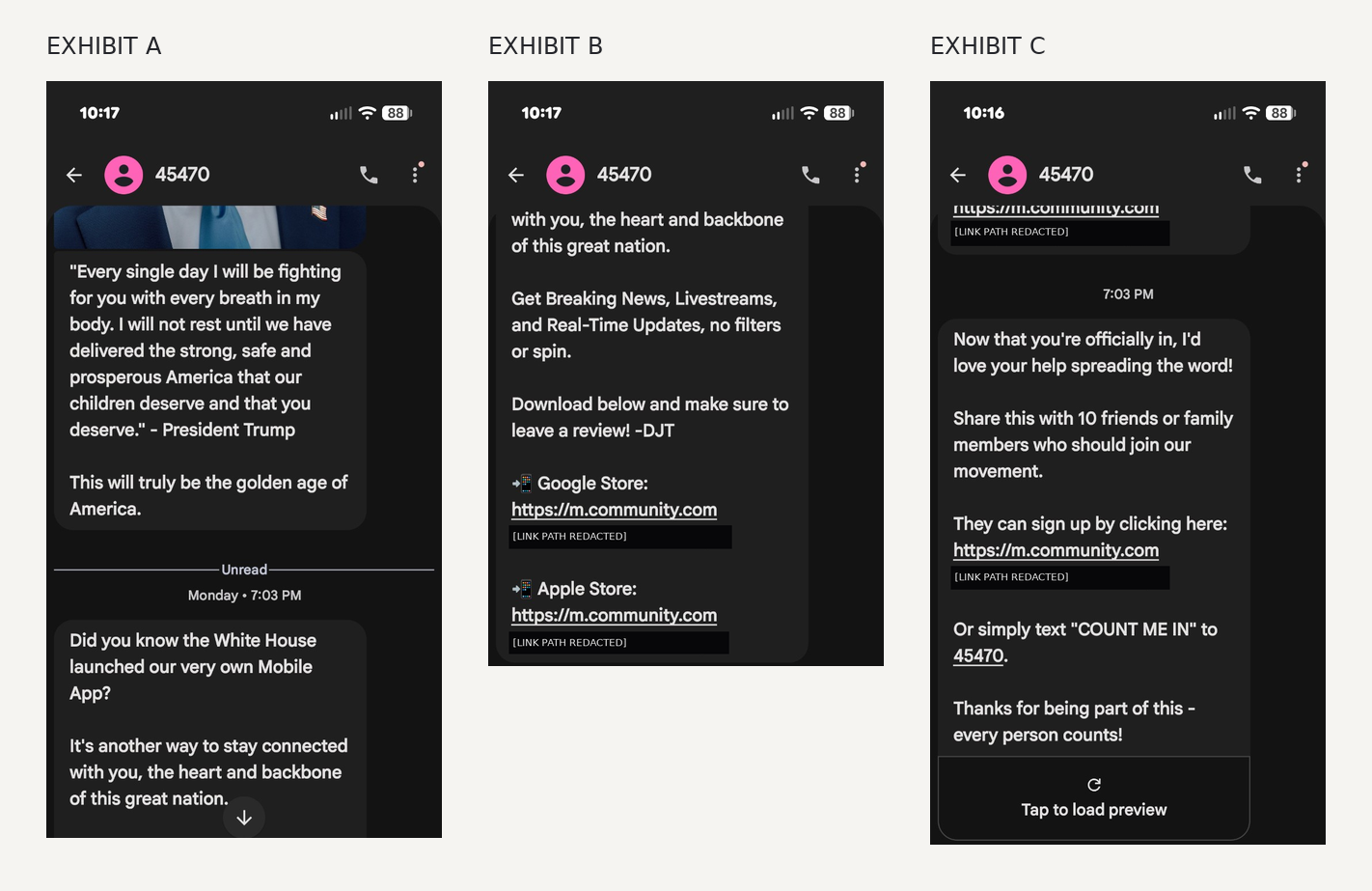
Subsequently, I received text messages from short code 45470, a number identified in published messaging-service terms as associated with the White House.
The messages included promotional material concerning the administration's mobile application.
One message encouraged recipients to download the application, receive updates, and submit a review.
Another informed me:
“Now that you're officially in, I'd love your help spreading the word!”
It proceeded to request that I share an enrollment invitation with ten friends or family members.
I confess that I found this development remarkable.
I had written to the President concerning the obligations of his office.
I was now apparently being invited to assist with the enlargement of his communications audience.
I do not recall the intervening act by which my petition became an application for membership.
I am therefore interested in discovering it.
III. On the Difference Between Contact and Consent
There are several possible explanations for the messages I received.
The White House correspondence system may be connected to a broader communications service.
The service may have received my number through an independent process.
I may have encountered enrollment language whose significance was not apparent to me when submitting my correspondence.
There may have been an administrative error.
I do not presently know.
I am quite willing to consider these possibilities.
What I am less willing to do is accept the announcement of enrollment as sufficient evidence that enrollment was knowingly requested.
There is a difference between providing the government with information necessary to receive a response and authorizing that information to be used for promotional outreach.
Whether the applicable disclosures and legal requirements permitted this particular use is a question that should be answered through examination of the actual records.
It cannot be answered by assuming that the existence of a subscription proves the existence of informed consent.
A system's ability to perform an action does not establish its authority to perform that action.
That distinction is not especially complicated.
Indeed, it is sufficiently elementary that I would prefer not to discover how many administrative processes depend upon overlooking it.
IV. On the Peculiar Request for Ten Additional Citizens
The invitation to recruit ten additional participants deserves separate consideration.
I do not dispute the legitimacy of voluntary political association.
Citizens are free to support political movements, subscribe to informational services, participate in campaigns, and encourage others to do likewise.
They are equally free to decline.
But there is something peculiar about addressing the President of the United States in the exercise of one's civic rights and subsequently being greeted as though one has volunteered for the advancement of his political interests.
The government does not acquire a supporter every time it acquires a correspondent.
Nor does the submission of criticism constitute an invitation to solicit the critic's acquaintances.
I find the number ten especially interesting.
It suggests an established recruitment procedure, presumably intended for an audience that has expressed some desire to participate.
I make no objection to such a procedure when directed toward willing participants.
I merely question its relevance to someone whose most recent identifiable interaction with the executive branch consisted of asking the President to consider the gravity of his own words.
The Republic has already received my participation.
I wrote the letter. I cast my ballot.
I would be grateful if the institution could attend to that contribution before requesting ten more.
V. On the Office and Its Occupant
There is a distinction that ought to survive every change of administration.
The President is an elected constitutional officer.
The presidency is an institution.
The government is not a membership organization requiring expressions of personal allegiance before citizens may communicate with it.
The First Amendment protects the right of the people to petition the government for a redress of grievances.
That right does not depend upon whether the government appreciates the petition.
It does not depend upon whether the petitioner voted for the officeholder.
It does not depend upon whether the correspondence contains praise, criticism, admiration, or disappointment.
A citizen may respect the office without endorsing its occupant.
A citizen may disagree with the occupant without rejecting the office.
A citizen may even commend the President in one paragraph and admonish him in the next.
These are ordinary exercises of independent judgment.
The President represents citizens who support him and citizens who do not.
This is a feature of republican government, not an administrative inconvenience to be corrected through subscriber acquisition.
I would hope that the systems responsible for presidential correspondence preserve this distinction.
If they do not, I would be interested in learning why.
VI. On the Difference Between Answering and Advertising
It is important to be fair.
The promotional messages I received may not have been intended as responses to my letter.
They may have been generated independently, without anyone involved in processing my correspondence having reviewed its contents.
I have no evidence establishing otherwise.
Nevertheless, their arrival presents a useful occasion to examine the distinction between receiving correspondence and cultivating an audience.
The original letter concerned statements made by the President about the potential destruction of American cities.
The subsequent messages concerned a mobile application and the recruitment of additional subscribers.
These are, I trust, recognizably different subjects.
I do not object to the existence of a White House application.
I do not object to the government informing the public of its activities.
I do not even object to receiving information concerning matters that interest me, provided the relevant subscription and consent requirements have been satisfied.
I object to the possibility that an institution might confuse my willingness to address it with my willingness to promote it.
The distinction is sufficiently important that I would prefer to see it maintained deliberately rather than accidentally.
And if the two communications systems are entirely unrelated, then the source of my enrollment should be readily identifiable.
VII. On the Matter of Administrative Competence
Much is said about efficiency in government.
I am sympathetic to the proposition that public administration should be efficient.
Efficiency, however, requires some attention to what the institution is attempting to accomplish.
A correspondence system exists to receive and process correspondence.
A promotional messaging system exists to distribute promotional messages.
Both may serve legitimate purposes.
Neither is improved by confusing the function of the other.
Should a citizen's telephone number move from one system into another, the institution ought to be capable of explaining the authorization and process through which that occurred.
Should no such transfer have occurred, the institution ought to be capable of identifying the independent enrollment.
Neither explanation requires an elaborate philosophical defense.
A record would suffice.
I would welcome one.
I would also welcome clarification of whether the White House considers submission of presidential correspondence to constitute an expression of interest in receiving promotional messages.
If it does, I would be interested in examining the reasoning by which that conclusion was reached.
If it does not, I would be interested in knowing what happened here.
It would be unfortunate to discover that the machinery of executive communication can identify ten hypothetical new subscribers more readily than it can identify the origin of one existing subscription.
VIII. On the Right to Remain a Citizen
I am aware that recipients of unwanted promotional text messages may generally request that such messages cease.
That is useful.
I may exercise that option.
But an unsubscribe mechanism answers a different question from the one I am raising.
It tells the recipient how to leave.
It does not necessarily explain how the recipient came to be enrolled.
And where the communication involves an official government institution, the latter question deserves consideration.
I would prefer not to speculate about the intentions of the people who designed or administered these systems.
I would rather examine their procedures.
Procedures are more useful than intentions when attempting to establish what actually occurred.
They can be documented.
They can be evaluated.
And, where necessary, they can be corrected.
I therefore ask a simple question:
By what affirmative act, disclosed authorization, or independent subscription was my telephone number enrolled in the messaging program associated with the White House?
I do not presume that a law was violated.
I do not presume that the enrollment was deliberate.
I do not presume that anyone intended to treat my correspondence as a declaration of political support.
I ask only that the institution distinguish what I actually did from what its messaging service has announced that I did.
That seems a reasonable expectation of an office entrusted with considerably greater responsibilities than maintaining a subscriber list.
IX. On the Republic
I wrote to the President because I believe the office carries obligations that deserve serious consideration.
I supplied my contact information because the official correspondence process requested it.
I did not regard either action as an application for political membership.
I remain willing to receive a substantive response to my original letter.
I remain willing to examine any explanation concerning the messages I subsequently received.
I remain willing to recognize an innocent administrative explanation if the evidence supports one.
What I am unwilling to do is confuse the exercise of citizenship with an expression of allegiance.
The distinction is older than the present administration.
It is older than the political parties now competing for office.
It is older, indeed, than the constitutional system in which this correspondence occurred.
Those entrusted with public authority have long faced the temptation to mistake the attention of the governed for approval of the governor.
A republic requires its institutions to resist that temptation.
The citizen is not obligated to admire the magistrate.
The magistrate is obligated to discharge the duties of the office.
And when a citizen approaches that office with a petition, the appropriate administrative response is to receive and consider the petition.
Not to presume the petitioner has joined the court.
I addressed the President of the United States.
I did not volunteer to recruit ten people for him.
I trust the distinction can be accommodated.
Makita R Thatcher
Macon, Georgia
October 16, 2026
Published as civic commentary and a request for administrative clarification. The author makes no allegation of unlawful conduct. Documentary exhibits reproduce communications received by the author, with identifying tracking information redacted.