Presidential correspondence & civic consent
On the Message That Continued
A Further Meditation on Presidential Correspondence, Civic Consent, and the Persistence of an Unanswered Question
Contents · Seven sections, authorities, and Exhibit D
I. On an Ordinary Afternoon
I was having my hair cut when the President of the United States sent me another message.
I should clarify that I have no reason to believe the President sent it personally, or that he knew I was having my hair cut. The distinction is worth preserving, particularly given the subject of the present inquiry.
The message came from short code 45470, a communications service associated with the White House from which I had previously received announcements. I had already written about this arrangement.
On October 16, I published On the Presumption of Allegiance, an inquiry into the circumstances in which a citizen who wrote to the President about the responsibilities of his office subsequently began receiving promotional messages. One of those messages invited me to recruit ten additional people.
I had not anticipated this. I had written as a citizen, not as a volunteer for the enlargement of anyone's political audience.
I therefore asked by what affirmative act, disclosed authorization, or independent subscription my telephone number had entered the messaging program. I acknowledged that there might be an ordinary explanation. I did not allege an unlawful transfer, a deliberate response to my criticism, or misconduct by any particular official.
I asked for the relevant record.
The communications have continued. The explanation has not yet appeared in the materials available to me.
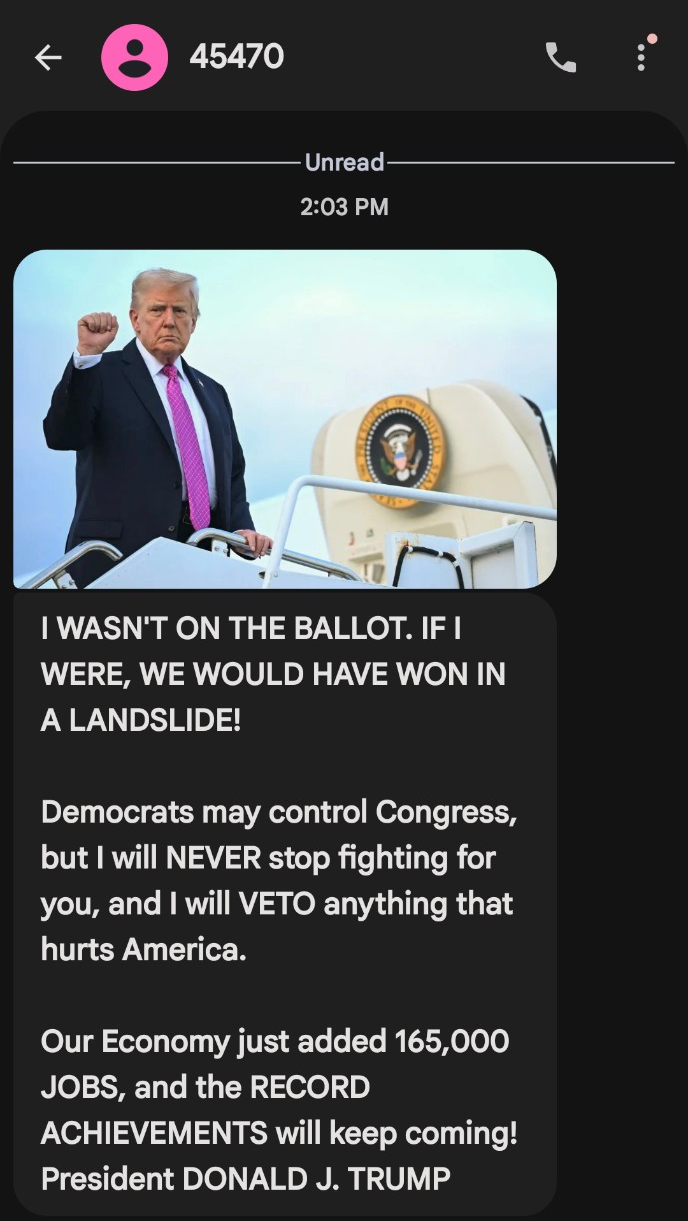
On November 6, the latest message arrived. The President, it seemed, had something to say about the election.
II. On the Election That Was Not Held
The text displayed a photograph of President Donald J. Trump standing on the steps of an aircraft, his fist raised. Beneath it appeared the declaration:
“I WASN'T ON THE BALLOT. IF I WERE, WE WOULD HAVE WON IN A LANDSLIDE!”
The message continued by referring to possible Democratic control of Congress, promising resistance through the presidential veto, and reporting favorable economic figures.
There is nothing unlawful in a President commenting on an election, expressing confidence in his political appeal, or criticizing the opposing party. The quoted sentence is properly treated as a political counterfactual. It neither changes an election result nor, standing alone, announces a legal claim to a new term of office.
It is nevertheless worth distinguishing the election that occurred from the one imagined.
The federal election on November 3, 2026, was a midterm election. Under Article I, section 2 of the Constitution, members of the House of Representatives are chosen every two years. Senators serve six-year terms arranged in staggered classes; the Seventeenth Amendment provides for their popular election. The presidency, by contrast, is a four-year office under Article II. There was no regularly scheduled presidential election in November 2026.
The Twenty-Second Amendment adds a separate restriction: no person may be elected President more than twice. President Trump was elected in 2016 and again in 2024. That restriction would be decisive if his remark were recast as a proposal for a third election to the presidency. The message does not expressly make that proposal. It should not be made to say more than it says.
Contemporaneous reporting projected Democratic majorities in both chambers. Those reports concerned the composition of the next Congress; individual results remained subject to the ordinary state canvassing and certification processes. The terms of the newly elected members generally begin at noon on January 3, 2027, under the Twentieth Amendment. An election result is not the immediate installation of a new Congress.
The President's announced willingness to veto legislation is likewise part of the constitutional arrangement, not an exception to it. Under Article I, section 7, a bill passed by Congress is presented to the President, who may sign it or return it with objections. Congress may override a returned veto by the constitutionally required two-thirds votes in both Houses. A President may announce his intentions in advance; the constitutional veto itself is exercised against legislation presented to him.
The electorate thus selected legislators, not a President. The President may dispute the wisdom of those choices, and the newly elected Congress may oppose his policies when its term begins. Neither fact makes the other branch constitutionally subordinate.
The difficulty with hypothetical elections is that they are unusually accommodating to the person imagining them. Actual elections require ballots and votes.
The distinction seemed sufficiently elementary that I had not expected to encounter it while contemplating an afternoon haircut. But the coincidence was mine to notice. The constitutional arrangement was everyone's to respect.
III. On the Audience
The political content of the November message has its own significance. Its delivery returns me to the narrower question that began this inquiry.
On October 11, I sent a letter through the official White House correspondence portal and supplied contact information requested by that process. That evening, my email account received a message entitled Welcome to the Golden Age, stating that I was on a White House communications list. A separate acknowledgment of my presidential correspondence arrived that evening as well.
On October 13, another White House email promoted text updates and explained how a person could enroll by sending a designated phrase to 45470.
These documents are not interchangeable. The correspondence system, email distribution list, and text messaging program may have distinct enrollment mechanisms, vendors, purposes, and records. Their temporal proximity does not establish that information moved from one system into another.
The welcome message establishes that the mailing system treated me as a recipient. The text messages establish that my telephone number received messages from the short code. The promotional instructions establish an advertised method for voluntary subscription. None of these records, taken alone, demonstrates the particular act through which I entered either audience.
An instruction explaining how to subscribe is not proof of how an existing recipient subscribed. An unsubscribe instruction may explain how to leave; it does not necessarily explain how one arrived.
The question is not whether citizens may volunteer to receive White House communications. Of course they may. The question is what act or disclosure, if any, authorized the use of my contact information in this instance.
That answer may be unremarkable. I would welcome its unremarkableness, provided it is documented.
IV. On the Office and Its Audience
The President holds a constitutional office. That office is not identical to its occupant, and the public is not identical to his chosen audience.
Presidential communications may legitimately inform citizens about governmental actions, public programs, and policy positions. An administration may defend its record and urge support for its proposals. Political persuasion is not, by itself, evidence of an administrative wrong.
But there remains a meaningful distinction between communicating with the public in the name of an office and presuming that a particular citizen has chosen to join a promotional list.
A citizen may seek official information without endorsing the official. A citizen may criticize an administration without rejecting the constitutional legitimacy of the presidency. A citizen may acknowledge the President's lawful veto power while disapproving of the way he proposes to exercise it.
And a citizen may read a message without agreeing with it.
None of these distinctions requires a theory about the private motives of those who designed a communications program. They require only a record sufficient to show what the program did and, where authorization is relevant, on what basis.
The republic does not become an audience merely because the executive possesses a mailing list.
V. On the Record That Has Not Appeared
The November 6 text was not the only communication I received that afternoon. At approximately 1:48 p.m. Eastern time, a White House weekly briefing reached my email account under the title The Fight Goes On: President Trump Remains Defiant. At 2:03 p.m., the text message appeared.
The email repeated the President's electoral counterfactual, described intended opposition to future legislation, and promoted text updates through the same short code displayed in my screenshot. These records help attribute the subject matter of the communication to the White House messaging program.
They do not identify the mechanism of my enrollment. They do not establish that an employee selected me individually. They do not show that my earlier petition caused the November message, or that anyone responsible for the messaging service saw the essay in which I questioned the subscription. I assert none of those things.
The materials do establish a simpler sequence: messages continued to arrive after I published an inquiry concerning their origin; the records made available to me still do not explain that origin.
If an independent subscription occurred, I would welcome its date, method, and applicable consent language. If enrollment followed an affirmative selection or disclosure associated with another interaction, I would welcome identification of that step. If the cause was error, an explanation of the error would be sufficient.
Not every unanswered question conceals misconduct. Sometimes it conceals nothing more interesting than a checkbox.
But neither a benign explanation nor a wrongful one becomes established merely because it is easy to imagine. I would rather examine the record.
VI. On the Invitation to Speak
The November 6 email contained an invitation beneath the heading “WE WANT TO HEAR FROM YOU.”
I found the invitation encouraging. I have, in fact, been communicating with the White House.
My original letter concerned presidential speech and the responsibilities of office. My subsequent inquiry concerned a messaging enrollment I did not understand. I received a response to the original presidential correspondence on October 22, but it did not substantively address the subject of my original letter or resolve the later enrollment question.
Here a legal distinction matters. The First Amendment protects the right to petition the government, but that protection does not ordinarily compel public officials to provide a personal or substantive response to every petition. I do not claim such a constitutional entitlement. My request for an enrollment explanation is a request for administrative transparency, not an assertion that a nonresponsive form letter is itself unconstitutional.
Communication nevertheless involves more than transmission. An institution may be quite good at sending announcements and less good at distinguishing the questions it has received.
I do not require the President to agree with my observations or personally investigate a subscriber record. I would simply welcome an explanation, from the appropriate operator of the relevant system, of the basis upon which the enrollment occurred.
That would not diminish the authority of the presidency. It would clarify the operation of a system using that authority's name.
VII. On the Citizen Who Remained
One could answer the President's message by disputing his hypothetical landslide. One could examine its economic claims or debate the use of the veto. Those are proper subjects for public argument.
They are not the question that began this correspondence.
I addressed the President as a citizen. I subsequently received promotional messages. I asked how my information entered the program. More messages arrived. An enrollment explanation has not yet appeared in the record available to me.
I remain willing to receive one.
The distinction at issue survives every change of administration. A person may petition a constitutional officer without becoming an adherent of that officer's political movement. A person may cast a ballot without endorsing the executive's interpretation of the result. And a person may decline promotional participation without withdrawing from the political community.
The President was not a candidate in the November 3 congressional election. I was not a candidate either.
I was, however, entitled to vote. I exercised that right. I exercised my right to petition as well.
Neither act transferred my judgment to the occupant of the office.
The people remain the people. The office remains the office. The President remains the President of the United States, including of citizens who would rather not receive his announcements.
I trust that distinction can be accommodated.
And as for the original question: I would still welcome the record.
There is no need for another declaration of victory. An explanation will do.
Makita R Thatcher
Macon, Georgia
November 6, 2026
Documentary Note & Authorities
This essay supplements On the Presumption of Allegiance (October 16, 2026). The author's received email records include the October 11 mailing-list welcome and separate correspondence acknowledgment; the October 13 text-alert invitation; the October 22 presidential-correspondence response; and the November 6 weekly briefing. Exhibit D reproduces the November 6 SMS screenshot.
These documents record communications received; they do not independently establish the source of SMS or email-list enrollment.
Constitutional references are supplied for readers who wish to examine the text. Election-majority descriptions reflect contemporaneous news projections rather than final certification.
This essay alleges neither unlawful use of personal data nor a personal response directed at the author.
Authorities
1. U.S. Constitution, Article I, §§ 2, 3, 7; Article II, § 1; Amendments XVII, XX, XXII.
2. National Archives, Amendments XI–XXVII (including the Twentieth and Twenty-Second Amendments).
3. 2 U.S.C. § 7 (congressional election timing) and Clerk of the House, Legislative FAQs (start of a new Congress).
4. Congressional Research Service, Veto Override Procedure in the House and Senate (Article I, § 7).
5. Minnesota State Board for Community Colleges v. Knight, 465 U.S. 271, 285 (1984) (petition does not generally compel an official response).
6. Associated Press, “Calling control of Congress in the 2026 midterm elections” (November 5, 2026) (news projections).
7. Makita R Thatcher, “On the Presumption of Allegiance” (October 16, 2026) (original essay and Exhibits A–C).
Documentary Exhibit D
Subsequent Text Communication
November 6, 2026
Short code: 45470
Displayed receipt time: 2:03 p.m.
Exhibit attached to On the Message That Continued.